
How To Properly Shoot A Pistol

Before you can improve pistol shooting accuracy and build your marksmanship skills, you need to learn how to properly shoot a pistol. Learning the fundamentals of pistol shooting is one of the most valuable investments any firearm owner can make.
Whether you’re brand-new to firearm ownership or recently transitioning to a more pistol-centric shooting journey, some steps and tips can help you.
When you nail the basics, you can begin tightening up your technique and building confidence. Then, over time, you’ll develop the proficiency to incorporate more advanced techniques into your shooting drills and learn to stay in control of every shot.
The good news is that you don’t need complicated techniques or years of experience to start improving. Focus on a few core pistol shooting fundamentals, such as grip, stance, sight alignment, trigger control, and follow-through. These elements will help you build a solid foundation.
Book a shooting experience at The Range 702.
Start With Safety First
Learning basic handgun safety rules needs to be the very first thing on your to-do list.
Every time you handle a firearm, you should:
- Treat the weapon like it’s loaded at all times.
- Keep your finger off the trigger until you are ready to shoot.
- Never point the muzzle at anything you are not willing to destroy. In practice, this means keeping your firearm pointed in a safe direction at all times.
- Know your target and what is beyond it.
When storing a firearm or handing it to another person, it should be unloaded and the action open. For carry or home defense purposes, follow the storage and readiness practices appropriate to your situation.
Here’s how to go about it:
- Eject the magazine.
- Lock the slide to the rear.
- Look into the open chamber to verify that no round is present.
- Touch the open breech with your index finger to physically verify it is unloaded.
While a visual inspection sounds like it should be adequate, physically inspecting the weapon offers an extra layer of protection and can reduce the risk of an accidental discharge.
When it’s time to load your weapon, unholster the pistol, retrieve a magazine, and point the weapon downrange. Insert the magazine and rack the slide to the rear to put the weapon into battery.
The Core Pistol Shooting Fundamentals
The fundamentals of marksmanship include these elements:
- Proper pistol grip.
- Handgun stance.
- Sight alignment and sight picture.
- Trigger control.
- Follow through on your shots.
These all work together. If you are lacking in one area, it can throw off your shot placement and accuracy. When you get these basics down, you’ll be able to consistently put rounds on target and shoot more accurately.
If you are just starting out, some elements may come naturally, and others may take more intentional work and practice. For example, depending on your hand size and dexterity, you may naturally have a solid grip on the handgun. However, learning to control the trigger and achieve slight alignment can be more challenging.
Be patient with yourself. Most shooters need several range trips before the fundamentals start to feel natural, and that is completely normal.
Practice makes perfect, but that doesn’t mean you should aimlessly dump hundreds of rounds of ammunition downrange. Shorter trips to the range tend to be more beneficial when you are learning the basics, as you will be fresh. Once you get fatigued, your fundamentals may slip.
Solidify Your Grip for Control
After you have the basics of safety down, you need to set the foundation for shooting a pistol accurately. That means developing a proper pistol grip. No handgun shooting technique will work if you don’t have a solid grip on the weapon.
With your dominant shooting hand, you should:
- Place your hand as high as possible on the backstrap, right up into the web of the grip.
- Wrap your middle, ring, and pinky fingers firmly around the grip.
- Keep your trigger finger straight along the frame until you are ready to shoot.
- Point your thumb forward along the frame, in the same direction you want the muzzle.
Be mindful of the slide, especially if your handgun doesn’t have a large, distinctive tang. If your hand is too high on the grip, the slide can strike it when you discharge a round. It will hurt and could injure your hand. This is what firearm instructors call a “self-correcting” mistake, because you won’t want to do it twice.
With your support hand:
- Fill the open space on the grip left by your dominant hand.
- Wrap your fingers over your shooting hand fingers.
- Place your thumb alongside and underneath the thumb of your dominant hand.
- Point both thumbs forward.
- Apply firm, even pressure.
When you grip the pistol with your dominant hand, the muzzle can cant toward the non-dominant side. Apply counter pressure with your support hand to help even out the muzzle.
However, you shouldn’t be squeezing excessively hard with either hand, as doing so will fatigue your grip. Think of it as a balancing act, not an exercise in pure grip strength.
Choosing the Right Handgun Stance
There are a few different handgun stances, which are as follows:
- Isosceles
- Weaver
- Fighting stance (staggered or modified weaver)
The isosceles stance is the simplest for most shooters.
Here’s how to position yourself:
- Stand with your feet shoulder-width apart.
- Slightly bend your knees.
- Lean forward slightly at the waist.
- Extend both arms evenly toward the target.
The isosceles is easy to learn and gives you a solid base to absorb recoil. The traditional isosceles can feel static, so most modern instruction teaches a more athletic version with the strong-side foot slightly back. If you need to move quickly, your reaction can be delayed.
The weaver stance, developed by Jack Weaver in the late 1950s, was widely adopted by law enforcement for decades. It has since been largely replaced in most agencies and competitive disciplines by the modern isosceles, which offers better recoil management and works well with modern body armor.
The weaver positioning is as follows:
- Blade your body with your shooting-side foot back.
- Turn your support side toward the target.
- Extend your shooting arm.
- Bend the elbow on your support arm.
While your hand positioning should be the same as outlined above, the angle of your arms creates a push-pull effect, which provides a lot of stability. One concern with the weaver in law enforcement context is that bladed positioning can expose the side panels of an officer’s body armor, which typically offers less coverage than the front and back plates.
The most recent of the three stances is the fighting stance, which is sometimes called the modified weaver or staggered stance. It’s a mix of the other two stances.
Here’s how to position yourself in the fighting stance:
- Keep your shoulders squared toward the target.
- Place your dominant foot slightly back.
- Keep your weight forward, slightly bending at the waist.
- Stay balanced and ready to move.
You’ll have a slight bend in your elbow, but not as extreme as with the weaver. If you find yourself in a dynamic situation, such as using your firearm for self-defense, you will be better positioned to move.
Sight Alignment and Sight Picture
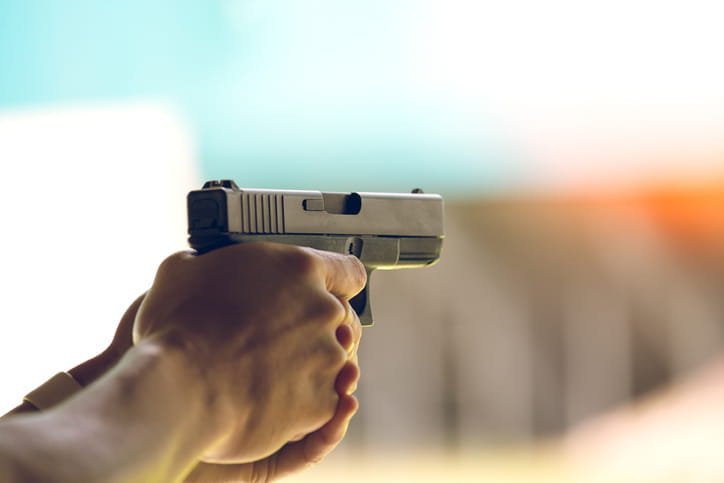
Before working on sight alignment and sight picture, you need to figure out which eye is dominant. Deciding if you should be shooting with one eye open or two is also part of this process.
For beginners, shooting with one eye open is the preferred choice. You can move on to the more advanced two-eyes-open technique once you get more comfortable.
Most people’s dominant eye corresponds with their dominant hand.
However, there are exceptions, so you need to check.
Here’s how to do that:
- Pick a smallish object across the room, such as a light switch.
- Form a triangle with your hands and hold it at arm’s length.
- Center the object in the triangle and look at it with both eyes open.
- Close one eye and then the other.
- Make note of which eye is open when you can see the object centered in the triangle.
Whichever eye is open when centered on the object is your dominant eye. That’s the eye you should leave open when shooting. The Cleveland Clinic provides a more detailed breakdown of your dominant eye, if you’d like to learn more about it and how it impacts your aiming process.
Now, you can move on to sight alignment and sight picture. Sight alignment means lining up your front and rear sights correctly. The front post should be centered between the rear sights. The top of the front sight is level with your rear sights.
Next, acquire your sight picture. Focus on the front sight or post. The target and rear sights should appear slightly blurry. Place the front sight where you want the shot to land.
Common Mistakes
Sight picture and sight alignment are elements of shooting fundamentals that many shooters struggle with.
Common mistakes include:
- Looking at the target instead of the front sight.
- Misaligning your sights.
- Rushing the shot.
You’ll need to reacquire sight alignment and sight picture after each shot. This process will be slow at first. That’s normal. Be patient and continue working on it.
Why Trigger Control Is the Biggest Game Changer
Trigger control is the absolute biggest factor that impacts where your rounds go. While that may seem surprising, it’s the factor with the most variables at play. When it comes to sight picture and sight alignment, you’re either aiming at the target or you aren’t. When you engage the trigger, you can throw your aim off and miss the target entirely.
Start by figuring out where to put your trigger finger in the first place. You should position the pad of your finger on the trigger. Do your best to center the pad on the trigger. When you are ready to fire, squeeze the trigger.
You’ve probably heard the phrase “Squeeze, don’t pull” before. What that means is you should be applying slow, steady pressure straight to the rear. You should almost be surprised when the gun goes off. If you jerk or slap the trigger, you will move the muzzle and send your rounds off target.
Slowly release the trigger until you feel the reset. Begin your next cycle until the weapon goes off. You can tell if you are jerking or slapping the trigger based on where your shots are impacting.
If you are aiming properly, but your shots are off target, see if they are going toward your dominant side or toward your support side. If the rounds are pulling toward your dominant side, you are jerking the trigger. If the rounds are pulling toward your support side, you are probably slapping the trigger.
Learning To Follow Through
What happens after the gun fires is just as important as what you do during the shooting process. Follow-through means maintaining your grip, sight alignment, and trigger control, even after the shot breaks.
Here’s what to do after each shot:
- Keep your sights on the target.
- Allow the gun to settle naturally.
- Reset the trigger smoothly.
- Prepare for the next shot.
Don’t let the gun drop or lower after you fire. Maintain a sound grip and a solid position. You want to develop sound habits now so that you can deliver effective follow-up shots once you get to that point in your shooting journey. Don’t let bad habits form now, as breaking them later will be tedious.
How To Practice and Get Better
When it comes to practicing, you have two main options. They are dry firing and live fire. You can get good at most of the basics by dry firing. What you can’t master with dry firing is the trigger squeeze and follow-through. You need to be doing both to become a proficient shooter.
Dry Firing
Dry firing means running through specific drills or motions with an unloaded weapon. The first step is to physically and visually inspect your weapon to verify that it is unloaded. You shouldn’t even have live ammo within arm’s reach when you are dry firing.
You can practice the following while dry firing:
- Drawing your weapon.
- Hand positioning and stance.
- Grip.
- Trigger squeeze.
- Sight picture and sight alignment.
- Holstering your weapon.
Sig Sauer offers some great tips on dry firing that you can incorporate into your firearms training when heading to the range isn’t practical. Check them out if you want to make dry firing part of your journey.
Live Fire at the Range
When you hit the range, focus on:
- Shooting slowly and deliberately.
- Watching your sights during recoil.
- Evaluating each shot.
If you need some help jumpstarting your progress, private pistol training in Las Vegas is a great option. An experienced instructor will evaluate your fundamentals and provide real-time feedback to improve your skills. Be patient and be a good student to make the most of your range time.
Apply what you learn when you practice independently. The more you practice, the more quickly you’ll progress.
Tips for Shooting a Pistol Accurately
A few quick ways to improve your results right away include:
- Practicing your stance and grip at home.
- Focusing on the front sight every time.
- Slowing down your trigger squeeze.
- Keeping your process consistent.
- Leaning slightly forward for better control.
- Practicing regularly.
If possible, shoot at least a few hundred rounds per month. Shooting is a perishable skill. If you don’t use it, you’ll lose it.
Train With a Professional at The Range 702
Hands-on instruction is one of the best ways to accelerate your progress. The Range 702 is a premier facility in Las Vegas, Nevada. Our team of experienced instructors prioritizes safety and learning while ensuring you have a great time.
Book a shooting experience at The Range 702.


